.png)
 2 weeks ago
18
2 weeks ago
18
Doha, November 25 (QNA) - There are bountiful massive investment opportunities for the Gulf Cooperation Council (GCC) states in the fields of artificial intelligence, robotics, and computing, with a strong emphasis on big data, experts in digital technology have underlined.
They highlighted the importance of orienting national strategies toward physical and spatial AI and robotics and establishing a connected intelligence framework to enhance the integration of urban life and smart city initiatives for sustainable development.
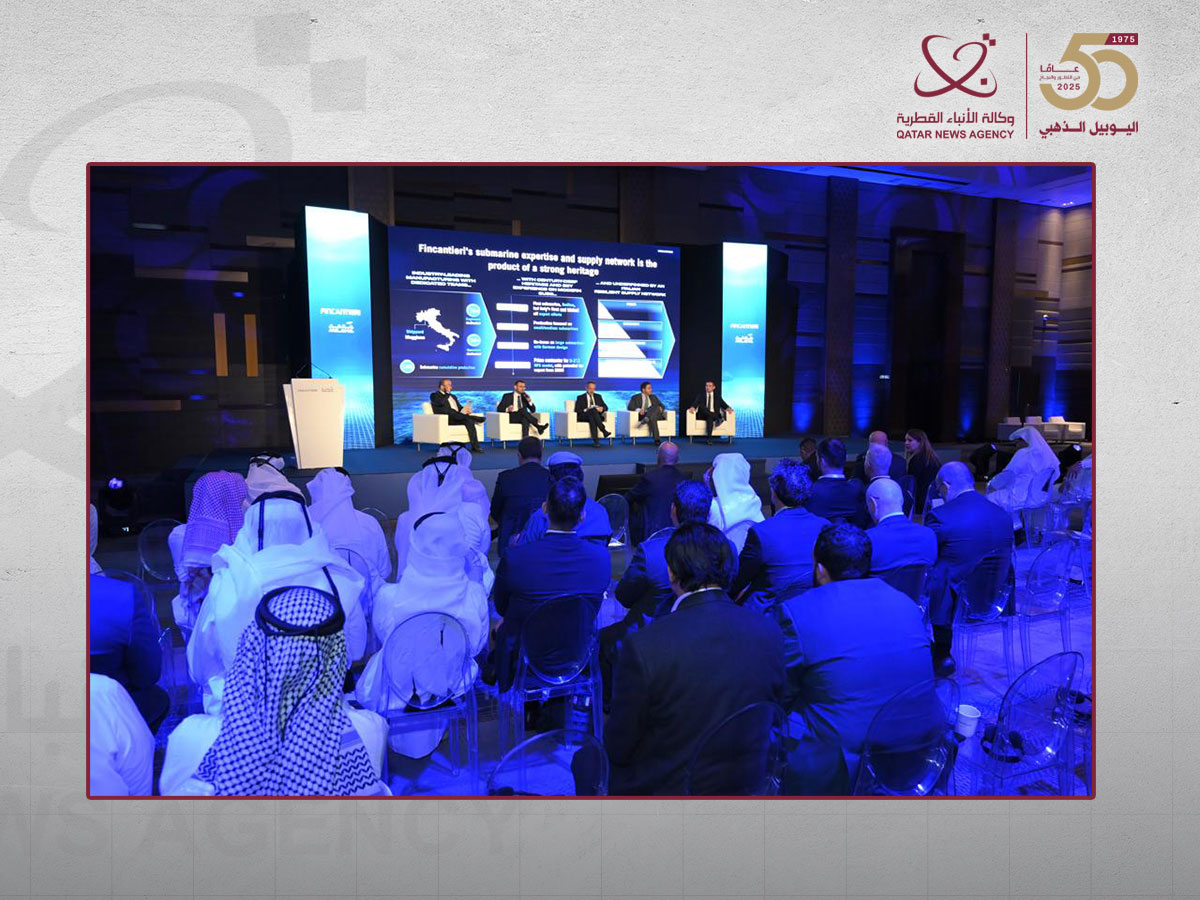
Having deliberated during a panel discussion on Tuesday within MWC25 Doha on "AI for a Hyper‑Connected Future", the experts explained that the AI future ushers in a new era of hyper-connectivity, where intelligent networks, robotics, advanced technologies, and generative AI models are reshaping the way people live, work, and interact.
AI has achieved integration across foundational models, telecommunications companies, AI-powered robotics, and infrastructure, driving institutional transformation, enhancing user experiences, and enabling more inclusive digital growth, they outlined.
This evolution, they noted, aligns with global trends in AI infrastructure, machine learning, and digitalization, underscoring the strategic importance of connected intelligence frameworks in fostering sustainable urban life and smart city initiatives, said experts in digital technology.
They noted that the era of generative AI will pave the way for embodied AI, capable of perceiving and figuring out the physical world, which is expected to create a paradigm shift in human-computer interaction and the ways humans and machines communicate.
The forthcoming era of connected intelligence rests on several key pillars, one of which is embodied or physical AI, incrementally evolving across humanoid robotics, drones, holographic imagery, and other virtual dimensions, providing modes of interaction with humans that go beyond conventional computers and mobile devices, the experts pointed out.
Another pillar, they outlined, is spatial AI, capable of understanding the physical world and initiating real-world actions, ushering in unprecedented opportunities for hyper-connected human-machine engagement.
They further noted that mobility across physical spaces leads to agent-based AI, where autonomous agent systems work collaboratively to execute tasks on behalf of humans, exploring how spatial agent environments operate in coordination with humans or robots to achieve complex objectives.
Regarding the future of device-based AI, encompassing holographic imagery and all forms of virtual entities, as well as the new architectures and models that will be required, they emphasized that super-intelligent AI is not merely a marketing term. Rather, it is attainable as the next stage: connected AI, a hyper-connected world that promises to transform human interaction, technology, and digital ecosystems on a massive scale.
The experts elaborated that connected intelligence comprises three layers: the cognitive layer, the embodied layer, and the connected layer.
These layers will offer unprecedented opportunities for innovation and active participation in the new frontier of connected intelligence, they figured out, stating that the future humanity is moving toward is not limited to connected AI alone, but also encompasses adaptive networks that constantly evolve and possess the capacity to perceive and understand the physical world, enabling a hyper-connected, intelligent ecosystem.
The AI-powered applications have experienced a colossal surge, accelerating institutional transformation, enhancing next-generation internet connectivity, improving user experiences, and supporting digital growth, they said.
The experts noted that professional telecommunications companies have deployed 60,000-plus private networks, and with the unprecedented acceleration of AI expansion, this convergence is not limited to technology alone but is set to reshape business models, infrastructure, services, and operational paradigms.
Given the technological edge, coupled with AI, exceptional economic growth opportunities are set to emerge, propelling the telecommunications sector to a new frontier of innovation, the experts averred.
This, they said, entails generating massive added-value momentum at scale, driven by the surging demand for AI-powered high-definition broadcasting links, especially with the rollout of next-generation products delivering higher speeds and deeper, immersive experiences.
The experts further indicated that operators are leveraging AI to optimize networks, manage energy, and enhance user experiences, shaping a hyper-connected, digitally empowered ecosystem.
Leveraging the AI advanced capabilities for business and production will reshape business models, services, infrastructure, and operations, in addition to enhancing efficiency and generating added value, the experts suggested.
They indicated that operators could unlock new revenue streams through service-based resources and strategies or reconfigure advanced networks by boosting user satisfaction and differentiating services.
The experts noted that AI has the colossal potential to bridge the skills gap and elevate the productivity curve from less productive to more productive, assisting relatively less productive individuals more than the highly productive, thereby further shortening the gap.
They emphasized that the key elements to focus on pertain to data privacy and security, vertically integrated enterprise solutions, and differentiating between general mass-market capabilities and large-scale production capacity. (QNA)